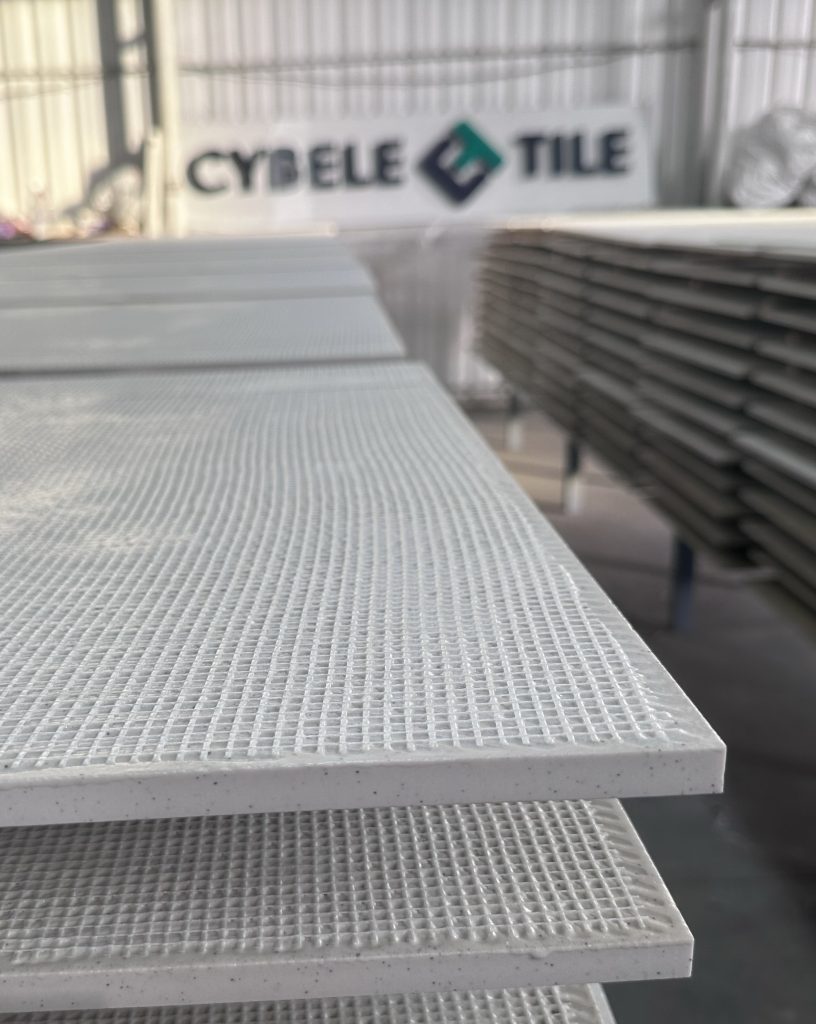
Mesh reinforcement is a structural strengthening method designed to increase the durability and mechanical performance of thin and large-format facade porcelain tiles. A fiberglass mesh is bonded to the rear surface of the ceramic panel using high alkaline resistant, thermally stable polyurethane or epoxy-based industrial adhesives. This reinforced layer enhances the slab’s flexural and tensile strength, provides controlled elasticity, and significantly reduces the risk of cracking or fracture. The application ensures improved structural reliability and secure handling during manufacturing, transportation, cutting, and mechanical or adhesive installation processes.
The mesh-backing process is particularly preferred for ultra-slim ceramic panels with thicknesses of 3–5 mm. In structures exposed to high wind loads or in open facade systems, it stabilizes the tensile forces occurring on the rear surface of the slab, ensuring a long-lasting and reliable application.
HIGH STRENGTH
Mesh reinforcement enhances the tensile strength and fracture resistance of façade ceramics, providing a durable and secure cladding system.
LONG-LASTING PERFORMANCE
Mesh-reinforced exterior facade tiles provide maximum resistance against outdoor weather conditions, temperature variations, and wind loads. They do not deform or develop surface cracks over time.
LIGHTWEIGHT AND STRONG STRUCTURE
For thin ceramic tiles, mesh reinforcement enhances mechanical strength while keeping the material lightweight, ensuring both aesthetic performance and structural efficiency.
AESTHETIC AND FUNCTIONAL BALANCE
Mesh-reinforced ceramics preserve surface integrity while offering architectural design freedom. Functional durability is combined with refined aesthetic expression.
SAFE HANDLING AND INSTALLATION
Fiberglass mesh reinforcement safeguards the ceramic tiless against potential damage at every stage, from manufacturing through transport and installation.
SYSTEM COMPATIBILITY
It provides full compatibility with adhesive bonding, clip-in, cassette, and various other mechanical façade systems, allowing easy integration into different installation techniques.”